
The Great Hercules Cluster (M13) is a heroic sight even through binoculars or a modest telescope. In the pristine dark skies of the Methow Valley, you can even spot it with the naked eye—provided you know exactly where to look. I remember the first time I saw this object in a telescope and it looked like diamond dust sprinkled on black velvet. It was truly gorgeous to behold.
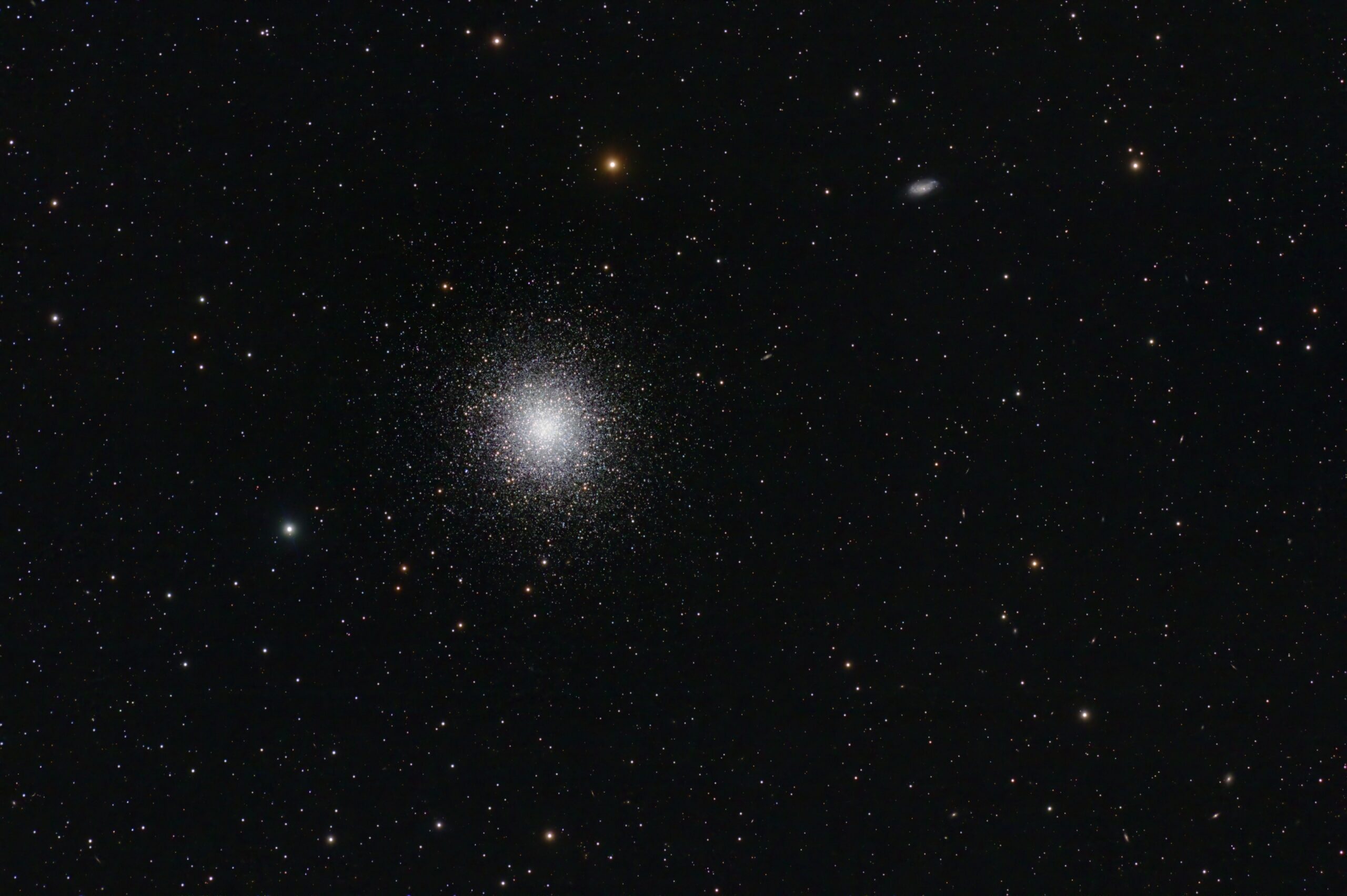
This object is a globular cluster: a tightly bound, spherical collection of hundreds of thousands of stars orbiting the core of our Milky Way. The stars within M13 are ancient, with some approaching the age of the observable universe itself. I’ve left this image uncropped to preserve the context of the surrounding deep space; a few distant galaxies and a sprinkle of foreground stars complete this celestial portrait.
In 1974, the Arecibo radio telescope beamed a message toward the cluster—a digital “Kilroy was here” for the cosmos. In about 22,000 years, if anyone there is listening, they might “hear” this brief broadcast from Earth. There is a certain quaintness in our assumption that radio waves are the pinnacle of interstellar communication. To a truly advanced civilization, it might seem as primitive as trying to signal a modern city across the globe using only the rhythm of distant drumbeats.
Hercules embodied the virtues of strength, endurance, and a tireless aspiration toward the sublime. Through his labors, he achieved apotheosis—finding himself immortalized forever in the starry heavens. Looking at this glowing, ancient city of stars in M13, we see those same qualities mirrored in the human spirit; a reminder of the brilliance that emerges when we, too, strive for the highest.