
I remember the first time I saw the Andromeda Galaxy (M31) with my naked eyes. A fuzzy patch of sky, like a ghostly whisper in the night floating in the Andromeda constellation adjacent to Pegasus the flying horse. I could not fathom the idea that my eyes are catching photons that have travelled millions of years (from my perspective) and perhaps photons from me are heading toward a sentient being in the Andromeda Galaxy to awe them millions of years into the future.
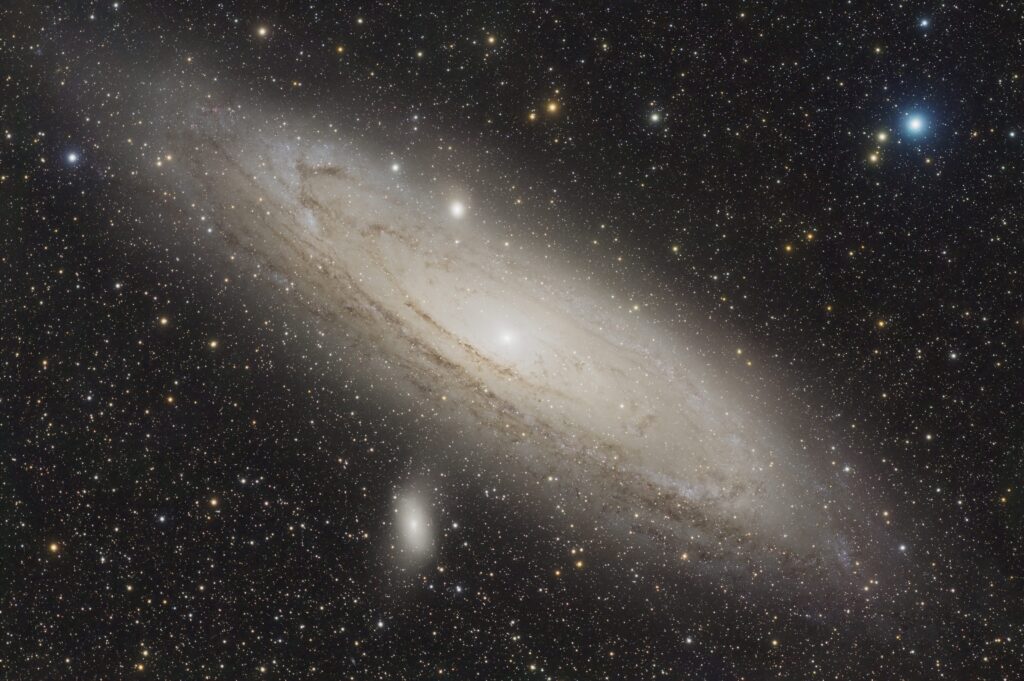
Andromeda is larger than our Milky Way galaxy and is moving in space toward us. We are gravitationally linked and similarly shaped, therefore often called a “Sister Galaxy”. It’s predicted that we may be headed for a collision, just like a sister might do. When I discuss this with friends, a quick look of terror might enter their eyes but I assure them it won’t occur for a long time, and since there is so much space between stars, a direct collision with the Sun is extremely unlikely.
In the photo you can see how much real estate the object occupies in space, filling the entire field of view. The challenge with imaging this beauty is maintaining enough dynamic range to capture detail at the core and the faint nebulosity on the edge. I like the beautiful blue star in the corner, and you can also marvel at the satellite galaxy, a curious companion orbiting like a loyal little brother. I spent several nights under good skies capturing 20 hours of total exposures which significantly improves signal to noise ratio as you can see in the photo.
In the late summer and fall, I encourage you to look up in a dark sky area and try to spot the Andromeda Galaxy. Ponder the miracle of a wave of light propagating through millions of light years of space to reach your retina, light up your neurons, and fill you with wonder and excitement. Meditate on the beings looking back on you with the same reverence. Look up, and remember: you are not just an observer—you are part of the story. Thank your Sister for such a moment.
Nice article. by looking at other Andromeda pictures I found out that the satellite galaxy is M110, the last Messier object added to the Messier catalog. I could not figure out what the blue star is but I assume that it is in our galaxy.
Yes, I think you’re right, Dean.