
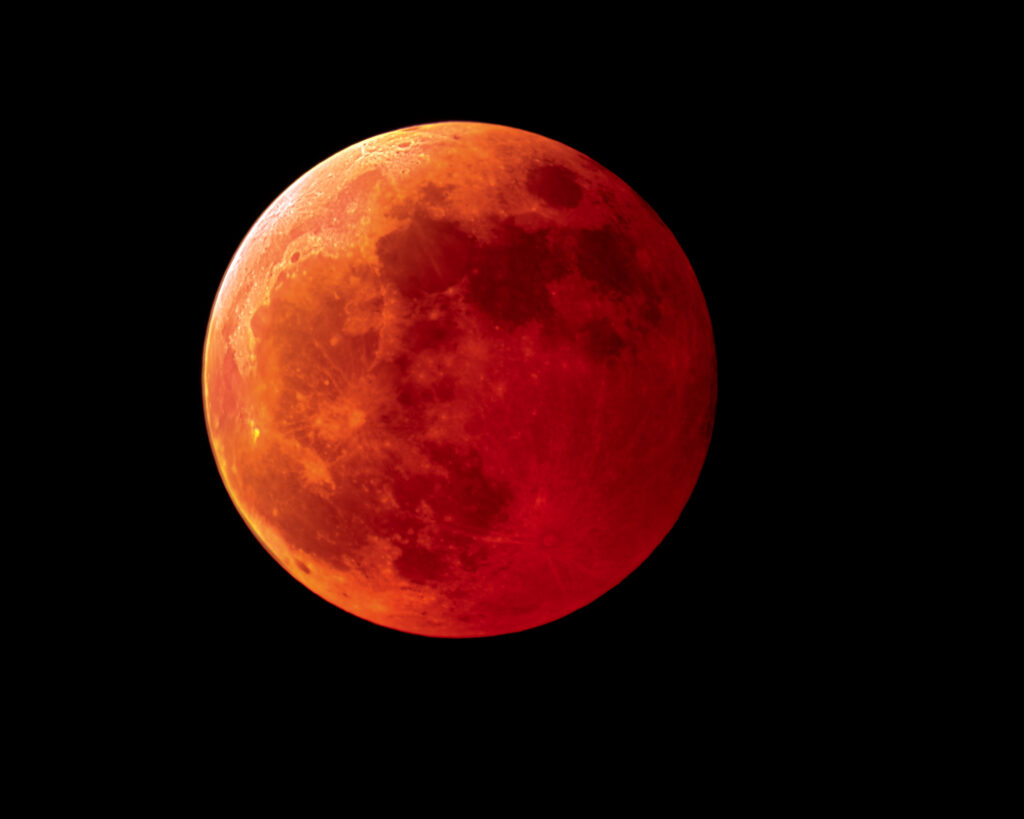
A lunar eclipse is an event not to miss if you have clear skies. These occur when the Moon enters Earth’s shadow, transforming the familiar ivory disk into a deep, copper-red phantasm. Even though this post is published after the March 3, 2026 Lunar eclipse, this shot was taken last year when the moon went deep into the umbral shadow. Even during a total eclipse the dynamic range of brightness on the Moon is significant and in post-processing I composited two exposures – one for the deep shadow and one the brighter limb – to resolve the dramatic contrasts between the ‘Blood Moon’ hues and the remaining light.
Many cultures attribute special significance to these lunar events. For example, the Batammaliba people in Togo and Benin see a lunar eclipse as a cosmic reset: a time of coming together and resolving old feuds and anger, as they believe the sun and the moon are fighting during an eclipse.[1]
Astrology suggests that lunar eclipses can influence human emotions and events. While there is no concrete scientific proof linking lunar eclipses to health problems, many people experience physiological and psychological changes during these events. Perhaps related to circadian rhythms these energetic shifts may induce sleep disruptions and effects on mental health and digestion.[2]
I hope you experience this alignment firsthand. May it spark a collective awakening and serve as a silent herald of peace, drawing us into closer alignment with the great cycles of the cosmos.
[1] National Geographic, “Lunar Eclipse Myths from Around the World”, Jane J. Lee, April 14, 2014
[2] Times of India, “Lunar Eclipse 2025: How it will impact on your health”, March 13, 2025