
The final image this season captured with the IMX585 sensor is the Crescent Nebula (NGC 6888) located in the constellation of Cygnus. Situated about 5,000 light years from Earth and spanning 25 light years across, this object is the beautiful creation of a rare, hot Wolf-Rayet star known as WR 136. About 250,000 to 300,000 years ago, the star shed its outer layers as it transitioned into a red supergiant. This expanding shell of gas collides with powerful stellar winds, energizing the surrounding material and illuminating the nebula. There is enough signal to discern fine wisps of gas—with bright H-alpha emissions highlighting the hydrogen structure, while an outer envelope of ionized OIII gas glows in vivid blue-green arcs hanging gracefully in space.
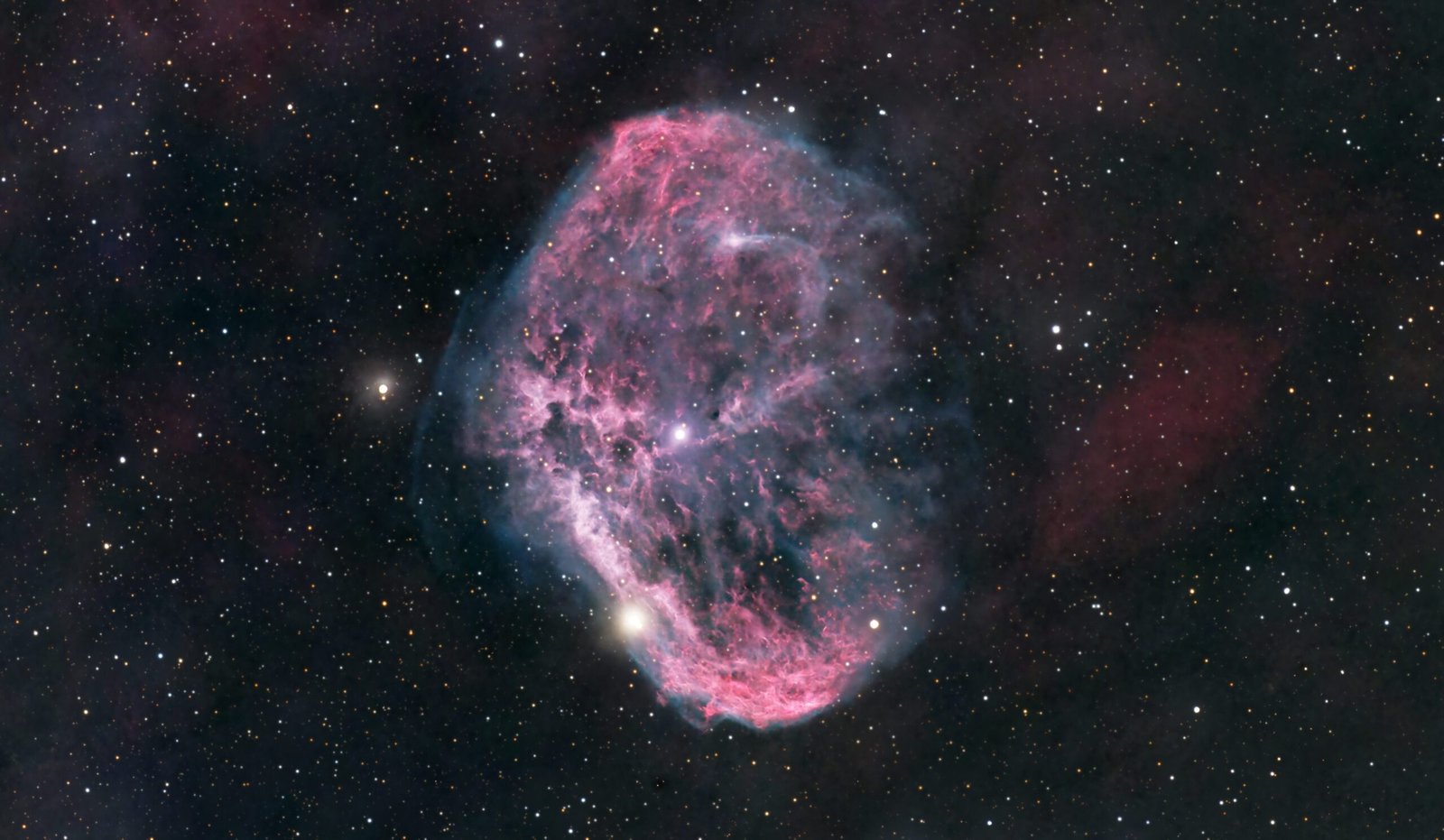
The fate of WR 136 is destined to culminate in a massive supernova. The star is massive—more than 15 times the mass of our Sun—and shines over 250,000 times brighter. This cosmic beast is devouring its fuel, burning bright and fast like a rock idol racing toward self-destruction. This image was collected over several nights, and the sensor frames it nicely to create a lovely composition, much better than earlier attempts!
As the days get shorter and we head toward long winter nights, my sights are set first to Casseopeia then the winter sky with Orion the Hunter. I will be switching back to my larger sensor in order to capture wide vistas of nebulosity and star fields, should the weather cooperate. Until then, I wish you well and please come back for more images soon!