
As galaxy season gives way to Milky Way season for astrophotographers in the Northern Hemisphere, I wanted to share a series of images captured using a new camera with a smaller sensor and smaller pixels (Sony IMX585), giving me a much higher pixel scale. Paired with my 740mm focal length refractor, it creates a fantastic setup for bringing out tight, intricate details in smaller deep-sky targets like distant galaxies and planetary nebulae.
I’ll start with the iconic Whirlpool Galaxy (M51), tucked neatly near the handle of the Big Dipper in Canes Venatici. I am continually entranced by this interacting pair—their sweeping structure irresistibly reminiscent of spiraling algal blooms swirling in ocean currents viewed from high above. It serves as a striking reminder that the forces molding our universe are fractal, echoing across vastly different scales of nature. Here, gravitational tidal interactions between the galactic pair carve out sweeping whorls of stars, gas, and dark dust lanes that dance in rhythm to the fundamental forces of cosmic creation and destruction.
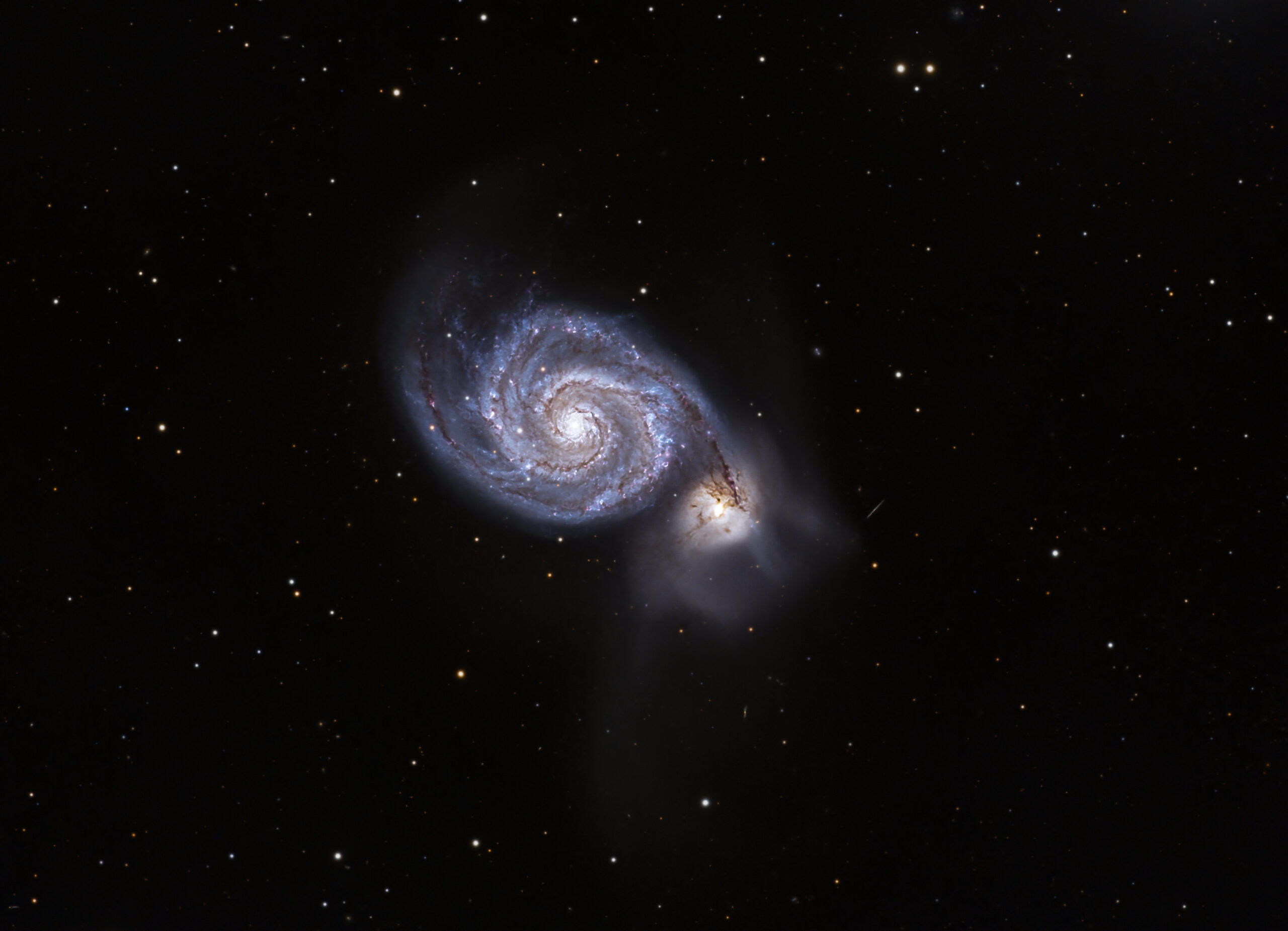
Beyond its breathtaking visual structure, M51 holds a special place in astronomical history: it was the very first celestial object recognized as having a spiral structure, observed by Lord Rosse in 1845 using his massive 72-inch telescope. Located roughly 23 million light-years from Earth, what we see as a single flowing entity is actually a grand-design spiral galaxy (NGC 5194) actively devouring and reshaping its smaller companion dwarf galaxy (NGC 5195). The immense gravitational tug-of-war between the two triggers massive shockwaves throughout M51’s spiral arms, compressing clouds of hydrogen gas and igniting furious bursts of brilliant blue star formation—visible as the bright, sparkling knots scattered along its dust lanes.
Leave that little galaxy alone you big bully!