
The Dumbbell Nebula (M27) is a planetary nebula, so called due to its round shape and vibrant colors. It is not a planet, but a star that has run out of gas to burn, sluffing off its outer atmosphere and leaving a spinning white dwarf at its center.
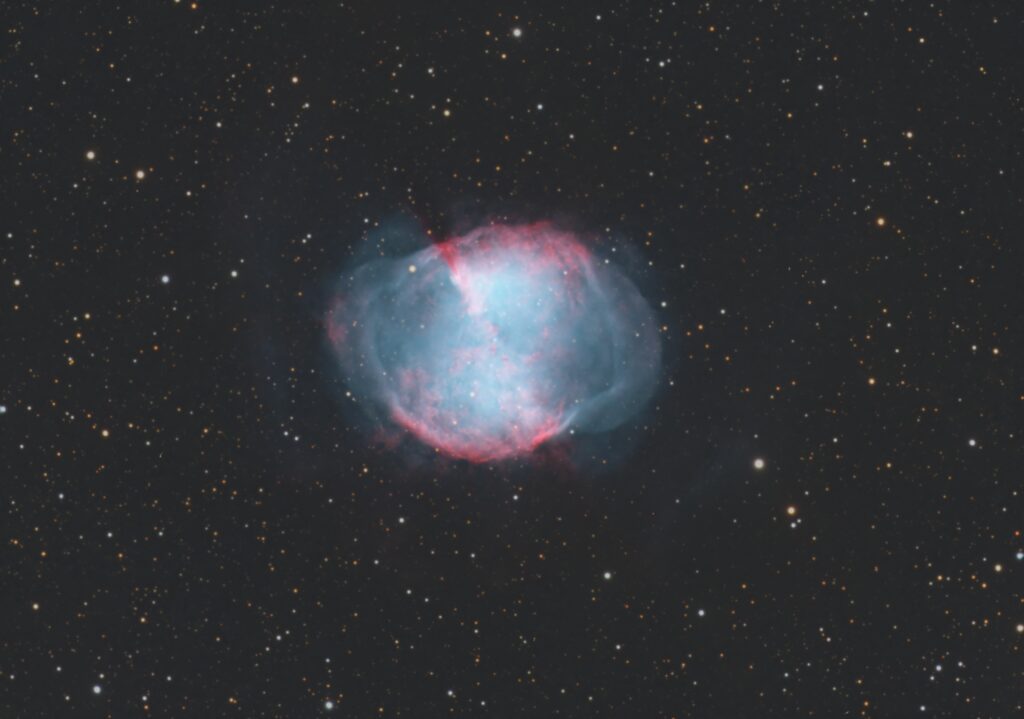
From two dimensions, it appears as a sphere with a dumbbell shape in the middle, narrow at the center and wide at the edge of the circle. Of course, this object is three dimensional and is more like a round toroidal object, picture a spherical donut. The dumbbell structures are dynamic vortices emanating from the central star, spinning and casting gas up from the center only to be pulled back down to the equator by magnetic and gravitational fields.
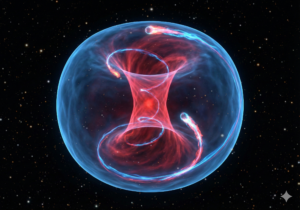
The torus is a ubiquitous dynamic in our universe, there is even evidence that our entire observable universe is a torus as if we live in a black hole.[1] [2] Inside the universe black holes exhibit toroidal structures with large jets shooting from the event horizon driven by the powerful dynamo and spin of the black hole and its surrounding disk of gas. Magnetic fields around planets are also tori, as are galaxies themselves. Supermassive black holes at the center of galaxies create a torus of dust and gas that moves up, out, and back creating conditions ideal for star formation and is thought to be the primary driver of star formation. See here. “We’re travelling in this boundless sea of infinite torus flow.”
[1] Pathria, R. K. (1972). “The Universe as a Black Hole.” Nature, 240(5379), 298–299.
[2] Popławski, N. J. (2010). “Cosmology with torsion: An alternative to cosmic inflation.” Physics Letters B, 694(3), 181–185.